Enterprise IT Helpdesk AI Agent!
Built using RAG, FastAPI, React, Qdrant, and Groq, this project features intelligent document retrieval, reranking, real-time streaming, source citations, and JWT authentication.
- Year
- 2026
- Area
- AI Engineering | LLM Engineering | RAG | Full-Stack Development
- Status
- Completed
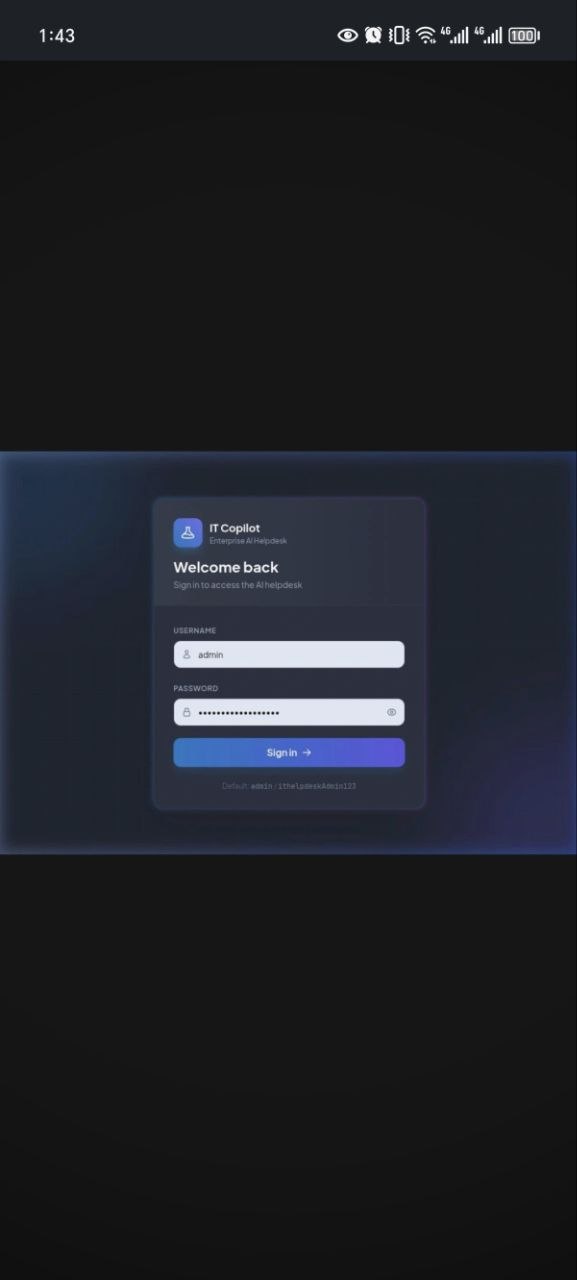
Overview
Enterprise IT Helpdesk AI Agent
An Intelligent Enterprise IT Support Assistant Powered by Retrieval-Augmented Generation (RAG)
Project Overview
Enterprise IT Helpdesk AI Agent is an AI-powered technical support assistant designed to help employees resolve IT-related issues through intelligent document retrieval and context-aware response generation.
The system leverages Retrieval-Augmented Generation (RAG) to transform internal IT documentation into a searchable knowledge base. Users can ask questions in natural language about technical troubleshooting, system configurations, software issues, and IT support procedures. The application retrieves relevant information from indexed documents, reranks the retrieved passages based on semantic relevance, and generates grounded responses using Large Language Models (LLMs).
Unlike traditional AI chatbots that rely entirely on pre-trained knowledge, this system retrieves information from organizational documentation before generating responses, helping improve answer relevance, traceability, and reliability.
Key Features
- RAG-Based Question Answering: Generates context-aware responses using retrieved information from internal IT documentation.
- Semantic Document Retrieval: Uses BGE-M3 embeddings to understand user queries and retrieve relevant document passages.
- Intelligent Reranking: Integrates BGE Reranker to improve the relevance and quality of retrieved context.
- Vector Database Integration: Uses Qdrant for efficient vector storage and semantic similarity search.
- Document Ingestion Pipeline: Extracts text from PDF documents, creates overlapping text chunks, generates embeddings, and indexes them in the vector database.
- Source Citations: Provides document references and supporting passages to improve answer traceability.
- Real-Time Streaming: Implements Server-Sent Events (SSE) for incremental response delivery.
- Secure Authentication: Uses JWT-based authentication to protect application endpoints.
- LLM Integration: Integrates Groq API with a multi-tier model fallback strategy for response generation.
- Relevance-Based Fallback: Uses retrieval relevance checks to handle questions when sufficient supporting context is unavailable.
Technical Architecture
The application follows a modular client-server architecture consisting of a React frontend, FastAPI backend, RAG processing pipeline, and Qdrant vector database.
The RAG pipeline consists of three major stages:
- Document Retrieval: User queries are converted into vector embeddings using BGE-M3, followed by semantic search against the Qdrant vector database.
- Context Reranking: The initial retrieved passages are processed using BGE Reranker to identify the most relevant information.
- Grounded Response Generation: The selected context is passed to a Groq-powered LLM to generate relevant answers with source citations.
RAG Configuration
- Embedding Model: BAAI/bge-m3
- Reranking Model: BAAI/bge-reranker-v2-m3
- Vector Database: Qdrant
- Embedding Dimension: 1024
- Chunk Size: 500 characters
- Chunk Overlap: 50 characters
- Initial Retrieval: Top 8 passages
- Reranked Context: Top 3 passages
- Similarity Metric: Cosine Similarity
Technology Stack
Programming Languages: Python, TypeScript
Frontend: React 19, Tailwind CSS, Vite
Backend: FastAPI, Python 3.11
AI & Machine Learning: Large Language Models, Retrieval-Augmented Generation (RAG), LangChain, BGE-M3, BGE Reranker
LLM Provider: Groq API
Vector Database: Qdrant
Authentication: JWT
Communication: REST API, Server-Sent Events (SSE)
Document Processing: PyPDF
Containerization: Docker, Docker Compose
Engineering Challenges & Solutions
- Retrieval Accuracy: Implemented a two-stage retrieval pipeline combining dense semantic search and neural reranking to improve contextual relevance.
- Hallucination Reduction: Introduced context-grounded generation and relevance-based fallback mechanisms to reduce unsupported responses.
- Response Latency: Implemented SSE-based streaming to improve the user experience during LLM response generation.
- Document Processing: Developed a modular ingestion pipeline for extracting, chunking, embedding, and indexing organizational IT documentation.
- System Reliability: Integrated a multi-tier LLM fallback strategy to improve response generation resilience.
Key Learning Outcomes
- Practical implementation of Retrieval-Augmented Generation systems.
- Building semantic search pipelines using vector embeddings.
- Working with vector databases and neural reranking models.
- Integrating LLM APIs into production-oriented backend applications.
- Designing modular REST APIs using FastAPI.
- Implementing real-time AI response streaming.
- Developing full-stack AI applications.
- Managing containerized application services using Docker Compose.
Project Links
GitHub Repository: https://github.com/Sakib-Hasan3/Enterprise-IT-Helpdesk-AI-Agent
Project Category: AI Engineering | LLM Engineering | RAG | Full-Stack Development
Role: AI Engineer & Full-Stack Developer
What I built
- - Built an end-to-end Retrieval-Augmented Generation (RAG) system for enterprise IT support.
- - Implemented semantic search using BGE-M3 embeddings and Qdrant vector database.
- - Integrated BGE Reranker for improved document retrieval relevance.
- - Developed a PDF document ingestion and knowledge indexing pipeline.
- - Integrated Groq-powered LLMs with a multi-tier model fallback strategy.
- - Implemented context-grounded responses with source citations.
- - Added real-time AI response streaming using Server-Sent Events (SSE).
- - Implemented JWT-based authentication and modular REST APIs.
- - Containerized application services using Docker Compose.
- - Designed a modular full-stack architecture using React and FastAPI.
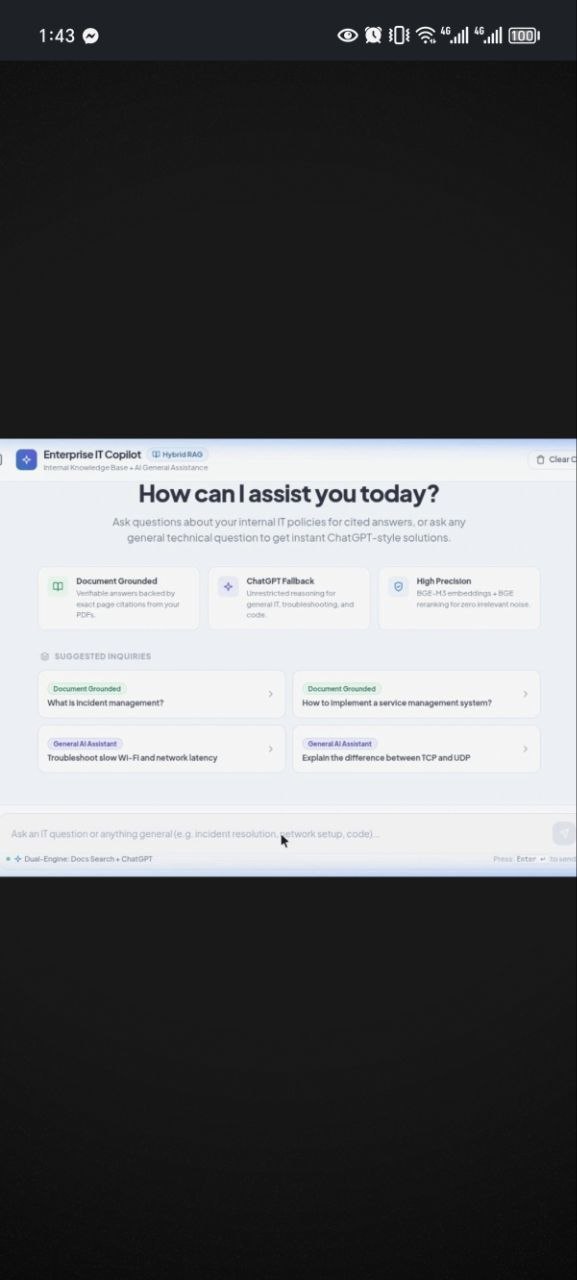
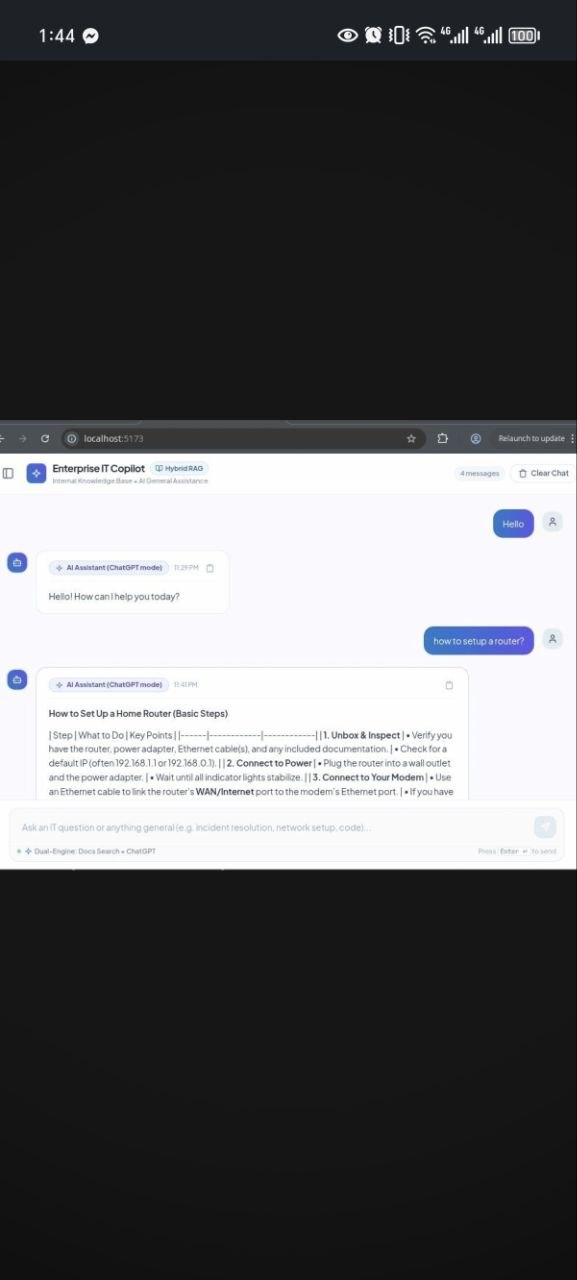
Screenshots

More projects

2026 — Generative AI
AI-Powered Intelligent Brochure Generator
An autonomous pipeline that scrapes a company's website, extracts brand intelligence with LLMs and produces a designed multi-page PDF brochure.
- Python
- Groq LLM
- Hugging Face
- Streamlit
- BeautifulSoup
- +2

2026 — NLP
Mentora – An AI-Based Mental Health Self-Awareness Platform
A full-stack NLP platform that classifies multi-class emotional sentiment across 100+ languages, with analytics dashboards and exportable reports.
- Next.js 15
- TypeScript
- FastAPI
- Hugging Face
- RAG
- +3